The use of two languages clearly adds to the literariness of this stanza from Ann Cotten's "Die Klassenfahrt":
Ich bin ein Pechvogel, darling
was willst du von mir
Das Gastschampoo
fällt ins Klo
I wanted to kill you
but you said no
so what are we for?
Jetzt sitzen wir da
und weinen bitterlich
und niemand ist froh
weil nämlich
es stimmt gar nicht
Notice how the rhymes are possible because of the shift in languages (froh instead of happy; the initial syllable of darling and da; you to match Gastschampoo; etc.). The words are chosen as much for their meanings as for their sounds. In fact, the shifting of language complements the theme of the whole poem. In translation, the stanza loses its power. If the original were all in German or all in English, it would lose not just its power but its point.
16 January 2011


14 January 2011
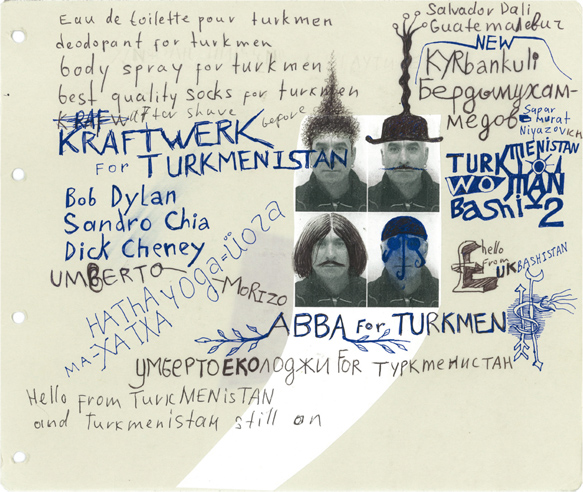
Multilingual visual poetry
At a much later stage, multilingual literary/aesthetic criticism should unpack the meaning or at least illuminate the creative process of multilingual visual poems like this one by Babi Badalov. The words/names in different languages are chosen not only for their visual appearance, but also for their meanings and sounds (it is poetry, or at least it is called such by the artist).
11 January 2011
Macaronic, yes, but not anymore
It is sad that a standard reference book, The New York Public Library Literature Companion (2001) perpetuates the prejudice against multilingual poetry through its definition of “macaronic verse”:
"MACARONIC VERSE. Verse that incorporates two or more languages. The form originated in the 15th century, when Tisi degli Odassi wrote comic poetry composed of vernacular words with Latin endings, but gained popularity through the work of his student, Teofilo Foleago. Poets since have exploited the humours potential of mixing languages. Less commonly, noncomedic poetry can also be referred to as macaronic, as in the work of Ezra Pound and T. S. Eliot."
The definition, by citing two of the greatest poets in the English language, deconstructs itself. Perhaps the word "macaronic" is similar to the word "negro." We cannot deny the historical fact that both words were indeed used in the past to denote a certain class of poems or people, but as the human race grew in wisdom, we have since abandoned those words for more accurate, less value-laden terms.
09 January 2011
Colloquium on Translingual Literature
From Natasha Lvovich comes this good news:
I am happy to announce that our Colloquium on Translingual Literature has been accepted for the International Symposium on Bilingualism (ISB 8) to take place in June in Oslo, Norway. I am very pleased that our group (of six people) representing a fascinating range of topics, cultures, languages, and authors will help view L2/bilingualism issues through the lens of literary text, creativity, and overall interdisciplinarity. I believe this is a step forward for both L2- and literature-related disciplines and a significant accomplishment for the emerging field of Translingual Writing. Congratulations to the participants and a call for attendance and support for all those who will be able to come to the conference and participate in our discussions!
If you will be in Oslo in June, don't miss this colloquium. It is one of the rare occasions when multilingual texts will be studied from the point of view of literary criticism in addition to linguistics.
I am happy to announce that our Colloquium on Translingual Literature has been accepted for the International Symposium on Bilingualism (ISB 8) to take place in June in Oslo, Norway. I am very pleased that our group (of six people) representing a fascinating range of topics, cultures, languages, and authors will help view L2/bilingualism issues through the lens of literary text, creativity, and overall interdisciplinarity. I believe this is a step forward for both L2- and literature-related disciplines and a significant accomplishment for the emerging field of Translingual Writing. Congratulations to the participants and a call for attendance and support for all those who will be able to come to the conference and participate in our discussions!
If you will be in Oslo in June, don't miss this colloquium. It is one of the rare occasions when multilingual texts will be studied from the point of view of literary criticism in addition to linguistics.
07 January 2011
Sound and sense
Paul Zumthor, in Toward a Medieval Poetics (1991), talks about “rhythm as a factor”: “Rules of rhythm played a major role in the poetic mutation that generated the medieval tradition, serving as both mold and catalyst. The line of verse was the seat of this mutation. If we examine the oldest poems in French or Occitanian, we find that rhythm, rhyme, syntax, and vocabulary are indissolubly interwoven in a way that reduces as far as possible the chance selection of an unpredictable linguistic feature.”
Things have not changed in poetry. A good poet chooses a word (whether in the main language or from a different language) not just because of the meaning of the poem (whether denotative or connotative) but because of its sound. The word must fit the rhythm (or meter) and the rhyme (or sound pattern of some kind) of the poem. This is one reason that studying a multilingual poem is very different from studying any other kind of written or spoken text by a bilingual or multilingual person. The poem is an artificial construct, artificial not in the sense of not real but artificial in the sense of deliberately constructed according to certain rules (i.e., artifice). The words in a poem are there because they not only help convey the meaning of the poem, but because they sound right. From the oldest poems to yesterday's poems in blogs (assuming the poems are good), the poet's choice of words is dictated not only by the mind (what the words mean), but by the ear (how the words sound) and, in the best poems, by the eyes (how the words look on the page).
05 January 2011
Research tips
Here's an account of some of the 20th century scholarship available to those interested in writing articles or books about the aesthetics of multilingual literary texts. This is from “Mixed Language Texts as Data and Evidence in English Historical Linguistics” by Herbert Schendl in Volume 1, page 57, of Studies in the History of the English Language: A Millennial Perspective (2002), edited by Donka Minkova and Robert P. Stockwell:
“Though there was some interest in ‘macaronic poetry’ before the 20th century, serious research only began with Wehrle’s study on medieval macaronic hyms and lyrics (1933). Wehrle establishes a typology of macaronic poetry from the 13th to the 15th centuries and classifies patterns of Latin insertions from a formal literary perspective, viewing them as ‘a genre of versification.’ The second half of the 20th century saw quite a number of literary studies on the aesthetic and poetic functions of language-mixing in macaronic poems, such as Zumthor (1960, 1963) in a European perspective, Harvey (1978) for Anglo-Norman lyrics, or Archibald (1992) for the poems of Dunbar and Skelton. These more recent studies emphasise the often highly artistic stylistic functions of poetic language-mixing.”
01 January 2011
Greetings
Gelukkige nuwejaar, voorspoedige nuwejaar, ilufio ètussé, Gëzuar vitin e ri, e glëckliches nëies, güets nëies johr, عام سعيد, shnorhavor nor tari, yeni iliniz mubarek, aw ni san'kura / bonne année, urte berri on, З новым годам, subho nababarsho, asgwas amegas, mbembe mbu, bonne année, sretna nova godina, bloavezh mat, bloavez mad, честита нова година, hnit thit ku mingalar pa, sun lin fi lok, kung hé fat tsoi, bon any nou, xin nian kuai le, xin nian hao, pace e salute, sretna nova godina, šťastný nový rok, godt nytår, sale naw tabrik, mbu mwa bwam, gelukkig nieuwjaar, happy new year, feliĉan novan jaron, head uut aastat, eƒé bé dzogbenyui nami, gott nýggjár, onnellista uutta vuotta, gelukkig nieuwjaar, bonne année, lokkich neijier, bon an, feliz aninovo, გილოცავთ ახალ წელს, ein gutes neues Jahr, prost Neujahr, kali chronia, kali xronia eutichismenos o kainourgios chronos, sal mubarak, nootan varshabhinandan, rogüerohory año nuévo-re, bònn ané, hauoli makahiki hou, שנה טובה, nav varsh ki subhkamna, nyob zoo xyoo tshiab, boldog új évet, farsælt komandi ár, selamat tahun baru, ath bhliain faoi mhaise, felice anno nuovo, buon anno, sugeng warsa enggal, akemashite omedetô, asseggas ameggaz, hosa varshada shubhaashayagalu, zhana zhiliniz kutti bolsin, sur sdei chhnam thmei, umwaka mwiza, seh heh bok mani bat uh seyo, sala we ya nû pîroz be, sabai di pi mai, felix sit annus novus, laimīgu Jauno gadu, feliçe annu nœvu, feliçe anno nêuvo, bonana, mbula ya sika elamu na tonbeli yo, laimingų Naujųjų Metų, gelükkig nyjaar, e gudd neit Joër, Среќна Нова Година, arahaba tratry ny taona, selamat tahun baru, nava varsha ashamshagal, is-sena t-tajba, kia porotu te ano ou, kia hari te tau hou, navin varshaachya hardik shubbheccha, ose:rase, Шинэ жилийн баярын мэнд хvргэе, wênd na kô-d yuum-songo, umyaka omucha omuhle, godt nyttår, bon annada, subha nababarsa, naba barsara hardika abhinandan, nawe kaalmo mobarak sha, سال نو مبارک, szczęśliwego nowego roku, feliz ano novo, ਨਵੇਂ ਸਾਲ ਦੀਆਂ ਵਧਾਈਆਂ, bun di bun onn, baxtalo nevo bersh, un an nou fericit, la mulţi ani, С Новым Годом, ia manuia le tausaga fou, nzoni fini ngou, bonu annu nou, bliadhna mhath ur, Срећна нова година, mwaha mwema, goredzva rakanaka, nain saal joon wadhayoon, suba aluth avuruddak vewa, šťastný nový rok, srečno novo leto, dobir leto, sanad wanagsan, feliz año nuevo, wan bun nyun yari, mwaka mzuri, heri ya mwaka mpya, gott nytt år, es guets Nöis, ia orana i te matahiti api, assugas amegaz, iniya puthandu nalVazhthukkal, yaña yıl belän, నూతన సంవత్శర శుభాకాంక్షలు, สวัสดีปีใหม่, tashi delek, losar tashi delek, tshidimu tshilenga, itumelele ngwaga o mosha, posa varshada shubashaya, yeni yiliniz kutlu olsun, gluk in'n tuk, Vyľ Aren, Щасливого Нового Року, З Новим роком, naya saal mubarik, yangi yilingiz qutlug' bo'lsin, Chúc Mừng Nǎm Mới, Cung Chúc Tân Niên, Cung Chúc Tân Xuân, ene boune anéye, ene boune sintéye, bone annéye, bone annéye èt bone santéye, blwyddyn newydd dda, bon lanné, dewenati, nyak'omtsha, a gut yohr, unyaka omusha omuhle, and in my own language (Filipino), manigong bagong taon!
30 December 2010
Limitations of any language
One of the persistent reasons many critics demand that a text be written completely in one language is the belief (long debunked) that every language is capable of expressing anything and everything. In particular, rabid defenders of the English language claim that the language can express any human reality. Writers know better. Even a consummate English user like T. S. Eliot was forced to use French and other languages every time he came up with a reality that the English language was incapable of handling. The silliness, however, is not limited only to English users. In Taiwan, using more than one language in a song (akin to poetry) is apparently frowned upon by the literati. Here is an account:
"The mainstream of the music industry works in accord with general attitudes of young Taiwanese. Mandarin is the language of their choice, although there are still some concepts that are better defined using Taiwanese or English, and that is where the code-mixing fits in. English is generally used for the purpose of adding prestige and an element of trendiness to a song, while Taiwanese is used to express an idea that Mandarin is incapable of expressing."
Like English, Mandarin is considered by its speakers as omnipowerful. It is interesting that a "smaller" language like Taiwanese has shown itself superior to Mandarin in certain cases. It is also interesting that, in Taiwan as in many other places, English is considered a prestige language. Truly, linguistics and literary criticism can never ignore political realities. Once China overtakes the United States in economic and military power (within our century!), we can be sure that Mandarin will be considered the prestige language, rather than English.
"The mainstream of the music industry works in accord with general attitudes of young Taiwanese. Mandarin is the language of their choice, although there are still some concepts that are better defined using Taiwanese or English, and that is where the code-mixing fits in. English is generally used for the purpose of adding prestige and an element of trendiness to a song, while Taiwanese is used to express an idea that Mandarin is incapable of expressing."
Like English, Mandarin is considered by its speakers as omnipowerful. It is interesting that a "smaller" language like Taiwanese has shown itself superior to Mandarin in certain cases. It is also interesting that, in Taiwan as in many other places, English is considered a prestige language. Truly, linguistics and literary criticism can never ignore political realities. Once China overtakes the United States in economic and military power (within our century!), we can be sure that Mandarin will be considered the prestige language, rather than English.
28 December 2010
Black authors necessarily multilingual?
This is the abstract of an article entitled "Expanding 'South Africanness': Debut Novels" (2009) by Margaret Lenta:
"In this article I examine a selection of debut novels published in South Africa in the period 1999 – 2008 in order to determine what inspired the authors to embark on the writing of prose fiction. A large number of such novels have been produced in this period, and most of them demonstrate the new freedom that authors feel to deal with subjects disapproved of or banned under apartheid. I have based my selection on the categories 'giving voice to previously silent communities'; 'sex and gender'; 'mixing languages', a phenomenon now characteristic of novels by black authors; 'writing back', that is, responding to and taking issue with earlier works; 'the roman à thèse', implying that the work becomes fictionalised argument. The final element is 'fusion', by which I mean that the novels register that people of different ethnic communities are now free to know each other outside of their work, and to form what ties they wish."
I wonder if it is true that mixing languages in a single work is now "characteristic of novels by black authors"? That would make multilingual novels mainstream, wouldn't it?
"In this article I examine a selection of debut novels published in South Africa in the period 1999 – 2008 in order to determine what inspired the authors to embark on the writing of prose fiction. A large number of such novels have been produced in this period, and most of them demonstrate the new freedom that authors feel to deal with subjects disapproved of or banned under apartheid. I have based my selection on the categories 'giving voice to previously silent communities'; 'sex and gender'; 'mixing languages', a phenomenon now characteristic of novels by black authors; 'writing back', that is, responding to and taking issue with earlier works; 'the roman à thèse', implying that the work becomes fictionalised argument. The final element is 'fusion', by which I mean that the novels register that people of different ethnic communities are now free to know each other outside of their work, and to form what ties they wish."
I wonder if it is true that mixing languages in a single work is now "characteristic of novels by black authors"? That would make multilingual novels mainstream, wouldn't it?
25 December 2010
Spanglish
The article "Spanglish: Speaking la Lengua Loca" (2007) by Ilan Stavans talks about the mainstreaming of a mixed language:
"Curiosity about Spanglish is abundant. Is it a dialect? Should it be compared with Creole? What are the similarities with black English? Will it become a full-fledged, self-sufficient language with its recognizable syntax? Linguists seem to have different responses to these questions. Personally, I answer to the latter question with a quote from linguist Max Weinreich, who wrote a multivolume history of Yiddish. Weinreich said that the difference between a language and a dialect is that the language has an army and a navy behind it. I also often call attention to the fact that in the last couple of decades, an effort to write in Spanglish has taken place in numerous circles, which means the form of communication is ceasing to exist at a strictly oral level. There are novels, stories, and poems in it already, as well as movies, songs, and endless Internet sites."
Multilingual literature does not have an army and a navy behind it, but it does count some of the world's best writers among its revolutionaries. As the history of the world shows, armies and navies eventually all surrender to the few, stout-hearted men and women of subversive movements.
"Curiosity about Spanglish is abundant. Is it a dialect? Should it be compared with Creole? What are the similarities with black English? Will it become a full-fledged, self-sufficient language with its recognizable syntax? Linguists seem to have different responses to these questions. Personally, I answer to the latter question with a quote from linguist Max Weinreich, who wrote a multivolume history of Yiddish. Weinreich said that the difference between a language and a dialect is that the language has an army and a navy behind it. I also often call attention to the fact that in the last couple of decades, an effort to write in Spanglish has taken place in numerous circles, which means the form of communication is ceasing to exist at a strictly oral level. There are novels, stories, and poems in it already, as well as movies, songs, and endless Internet sites."
Multilingual literature does not have an army and a navy behind it, but it does count some of the world's best writers among its revolutionaries. As the history of the world shows, armies and navies eventually all surrender to the few, stout-hearted men and women of subversive movements.
19 December 2010
The spoken mode in fiction
Here's the table of contents of the book The Representation of the Spoken Mode in Fiction: How Authors Write How People Talk (2009), edited by Carolina P. Amador-Moreno and Ana Nunes:
Table of Contents
Foreword by Prof. Michael McCarthy, University of Nottingham
Acknowledgements
Introduction
Writing and Reading Diglossia: Evidence from the French-speaking World – Rainier Grutman, University of Ottawa
Abstract
Introduction
Understanding diglossia
Writing diglossia
Reading diglossia
Textual evidence
Double-Dutch
Colonial creole
Maghrebi mix
Another form of hybridity
References
Code-Mixing in Biliterate and Multiliterate Irish Literary Texts – Tina Bennett-Kastor, Wichita State University
Abstract
Introduction
Structural categories of mixing and switching
Functional categories of mixing and switching
Multilingualism and multiliteracy in Ireland
Code-switching in theory and practice
Code-switching in spoken Irish
The texts
Conclusion
References
“Preserving every thing Irish”? The Hiberno-English Dialect of Kevin McCafferty, University of Bergen
Abstract
An oral writer?
Carleton’s peasant Hiberno-English
National writer, national dialect?
General English forms
Northern Hiberno-English forms
General Hiberno-English forms
Southern Hiberno-English forms
A levelled (Southern) dialect
Irish, not Scots
References
Representing Voice in Chicano Theater Through the Use of Orthography: An Analysis of Three Plays by Cherríe Moraga – Carla Jonsson, University of Stockholm
Abstract
Introduction
Code-switch – Lukas Bleichenbacher, University of Zurich
Abstract
Introduction
Code-switching: fiction and reality
Data and method
Situational code-switching
Metaphorical or marked code-switching
Indexical code-switching
Edited code-switching
Results and conclusions
References
Imitating the Conversational Mode in Audiovisual Fiction: Performance Phenomena and Non-clausal Units – Roberto Antonio Valdeón Garcia, University of Oviedo
Abstract
Introduction
Performance phenomena
Repeats
Non-clausal units: inserts
Conclusions
References
Index
Acknowledgements
Introduction
Writing and Reading Diglossia: Evidence from the French-speaking World – Rainier Grutman, University of Ottawa
Abstract
Introduction
Understanding diglossia
Writing diglossia
Reading diglossia
Textual evidence
Double-Dutch
Colonial creole
Maghrebi mix
Another form of hybridity
References
Code-Mixing in Biliterate and Multiliterate Irish Literary Texts – Tina Bennett-Kastor, Wichita State University
Abstract
Introduction
Structural categories of mixing and switching
Functional categories of mixing and switching
Multilingualism and multiliteracy in Ireland
Code-switching in theory and practice
Code-switching in spoken Irish
The texts
Conclusion
References
“Preserving every thing Irish”? The Hiberno-English Dialect of Kevin McCafferty, University of Bergen
Abstract
An oral writer?
Carleton’s peasant Hiberno-English
National writer, national dialect?
General English forms
Northern Hiberno-English forms
General Hiberno-English forms
Southern Hiberno-English forms
A levelled (Southern) dialect
Irish, not Scots
References
Representing Voice in Chicano Theater Through the Use of Orthography: An Analysis of Three Plays by Cherríe Moraga – Carla Jonsson, University of Stockholm
Abstract
Introduction
Code-switch – Lukas Bleichenbacher, University of Zurich
Abstract
Introduction
Code-switching: fiction and reality
Data and method
Situational code-switching
Metaphorical or marked code-switching
Indexical code-switching
Edited code-switching
Results and conclusions
References
Imitating the Conversational Mode in Audiovisual Fiction: Performance Phenomena and Non-clausal Units – Roberto Antonio Valdeón Garcia, University of Oviedo
Abstract
Introduction
Performance phenomena
Repeats
Non-clausal units: inserts
Conclusions
References
Index
We can see from the table of contents that this is a book which should be extremely useful to a multilingual literary critic. Unfortunately for me, I can't afford it, since it sells for US$ 109.95. Starving critics are poorer than starving writers!
18 December 2010
Luis Alberto Urrea
Readers know by instinct that the use of several languages in a literary work must have something to do with the meaning of the work. Here, for example, is a Book Club guide question to the novel Into the Beautiful North (2009), by Luis Alberto Urrea:
"Language and dialect play an integral role in the novel’s style. Spanish words and phonetic spellings are laced throughout, and Spanglish and slang are used on both sides of the border. What does Urrea achieve by mixing language in this way? What does it say about the ability of language to bridge—or not to bridge—cultural gaps?"
One can imagine ordinary booklovers (not professional literary critics nor even students in a literature class) asking themselves why a text would have more than one language, why utterances in other languages should not be translated into the main language (the way many novels do), why monolingual readers are being asked to read words that they cannot understand. Such first-level questions (we can no longer call them "naive" because of political correctness) should hopefully lead to deeper questions about the nature of literature itself, about why literary texts need (or do not need) to mirror reality, which at this time in humanity's history is multilingual.
"Language and dialect play an integral role in the novel’s style. Spanish words and phonetic spellings are laced throughout, and Spanglish and slang are used on both sides of the border. What does Urrea achieve by mixing language in this way? What does it say about the ability of language to bridge—or not to bridge—cultural gaps?"
One can imagine ordinary booklovers (not professional literary critics nor even students in a literature class) asking themselves why a text would have more than one language, why utterances in other languages should not be translated into the main language (the way many novels do), why monolingual readers are being asked to read words that they cannot understand. Such first-level questions (we can no longer call them "naive" because of political correctness) should hopefully lead to deeper questions about the nature of literature itself, about why literary texts need (or do not need) to mirror reality, which at this time in humanity's history is multilingual.
15 December 2010
Amazing Amazing Grace
That it is important to sing (equivalent to reciting or writing or reading poetry) in many languages is recognized by people outside multilingual literary circles. Of course, a motivation was the setting of a world record, but interviews after the event had the singers saying that the world record was only secondary to being able to pray in many languages. Here's an account of the event:
 Manila, Philippines
Our Amazing Guinness World Record Attempt!
Manila, PhilippinesAmazing Grace at EN2010
On Friday, July 23, Every Nation Ministries made an official attempt to set the Guinness World Record for “The Most Languages Performed in a Song (Multiple Singers)” by performing “Amazing Grace” in 50 different languages.
Background on the attempt:
The Guinness World Record attempt was performed during EN2010, the world conference of Every Nation Ministries. Every Nation has churches and ministries in 61 nations and has a vision to plant a church in “every nation” of the world. Thus, singing “Amazing Grace” in 50 different languages was chosen for the Guinness World Record. In the Philippines, Every Nation is represented by Victory Church which has 14 congregations in Metro Manila and 42 provincial churches outside Metro Manila.
This world conference is only held once every three years – the previous conference, EN07, was held in Araneta Coliseum with more than 14,000 participants from 41 different nations. This time, EN2010 was held at the SMX Convention Center with 19,173 participants from 45 different nations.
10 December 2010
João Guimarães Rosa
Here is an example of why everything gets lost in the translation of a multilingual novel (considered the best Brazilian novel):
We have no idea, from the English translation, how the languages worked to help each other out and make the text more complex.
"Born June 3, 1908 in Cordisburgo state of Minas Gerais, Rosa, the greatest Brazilian author since Joaquim Maria Machado de Assis (1839-1908), came from a wealthy patrician family. He earned a medical degree and worked as a doctor and a diplomat before publishing in 1946 his first book, Sagarana, a collection of short stories. Grande Sertão: Veredas (Big Backlands: Pathways, The Devil to Pay in the Backlands in the American translation) was published in 1956.
"Rosa was responsible for inventing a new language mixing regional slang to Indian dialects and modern and archaic Portuguese and foreign languages. Grande Sertão: Veredas is the pinnacle of this accomplishment. The novel's story is an endless monologue told in the first person by Riobaldo, an ex-bandit, who with unfinished sentences and invented words recalls what happened to him and sexually-ambiguous character Diadorim in the backlands, starting at the end of the nineteenth century.
"He died at his home in Copacabana, Rio de Janeiro, on November 19, 1967, of a heart attack just three days after being formally received at the Academia Brasileira de Letras. The author, who had a nearly fatal heart attack in 1962 was chosen in 1963 to become an 'immortal,' but refused to join the other 39 members of the Academy of Letter fearing 'the emotion of the moment.'
"A sample from Grande Sertão: Veredas extracted from the episode known as the 'Slaughter of the Ponies,' which was eliminated from the US translation:
"I can't remember how many days and nights it was. I'd say six, but I may be telling a lie. And if I hit on five or four, I may be telling a whopper. I only know it was a long time. It dragged on for years, sometimes I think. And at other times, when I consider the problem, in a different light, I think it just flitted by, in the whiz of a minute that seems unreal to me now, like a squabble between two hummingbirds.... We were trapped inside that house, which had become an easy target. Do you know how it feels to be trapped like that and have no way out?... I can tell you—and say this to you so you'll truly believe it—that old house protected us grudgingly: creaking with complaint, its dark old rooms fumed. As for me. I got to thinking that they were going to level the whole works, all four corners of the whole damn property. But they didn't. They didn't, as you are soon to see. Because what's going to happen is this: you're going to hear de whole story told."
We have no idea, from the English translation, how the languages worked to help each other out and make the text more complex.
06 December 2010
Divortiare
Another novel that mixes languages is Divortiare by Ika Natassa.
Here is a description: "Divortiare is a novel which includes dialogues containing English. The characters in this novel often mix bahasa Indonesia with English or even switch from bahasa Indonesia into English. Sometimes they also use ethnic languages such as Javanese or Bataknese."
Here is an excerpt:
Here is a description: "Divortiare is a novel which includes dialogues containing English. The characters in this novel often mix bahasa Indonesia with English or even switch from bahasa Indonesia into English. Sometimes they also use ethnic languages such as Javanese or Bataknese."
Here is an excerpt:
Denny memelukku. Not this passionate-I-just-want-to-feel-you-up hug, but a warm, close, hug.
Tenggorokanku tercekat, dan aku cuma bisa berkata pelan, “You don’t want to be with me, Den. I’m ruined.”
Ada rasa lega yang menjalar di sekujur tubuhku saat mendengar jawabannya.
“Let me fix it.”
Aku mengangkat kepalaku dari pundaknya, dan ia tersenyum menatapku.
“I can fix it. And I will. If you just let me.”
“But it’s gonna take a while, Den. It’s gonna take a long while.”
“Then we have all the time in the world to make you fall in love with me, right ?”
03 December 2010
Novel a-borning
On 17 October 2009, Rosine Caplot wrote in her blog:
"I have no clue what I will write about. It will probably be a crime novel, with a very wicked murderer and a very smart detective. Or just a few of the fantasies I have in my head. Except for the sexual ones maybe. Or should I add them too?
"I have no clue what I will write about. It will probably be a crime novel, with a very wicked murderer and a very smart detective. Or just a few of the fantasies I have in my head. Except for the sexual ones maybe. Or should I add them too?
"I also haven’t decided which language I’m going to write in. Víkþórr and I had the idea of writing a multilingual novel together, mixing all kinds of languages. For example,
And when Óláfr saw what 田中さん had done, he said: «Þú skalt deyja, því at þú hefir stolit vínbér frá mér!». 田中さん answered: 「すごいはオーラフル。」.
"I think that’s a very cool idea, even though nobody else would understand it of course. However, my intuition is telling me to write alone this time. I haven’t made up my mind about the language yet.
"This language mixing thing certainly is interesting!"
Yes, indeed, mixing languages in one literary text is very interesting, not just for readers but for writers. I wonder if she and her friend ever started or finished the novel?
30 November 2010
Code-switching as characterization technique
There is an interesting idea in the [unedited] abstract of "The code mixing and the social situation in the language of narration and the characters conversation in the novel 30 Hari Mencari Cinta" by Jeffry Widiatijono:
"Kachru (1978) proposes that code-mixing is the use of one or two languages which has constant linguistic transfer from one to another language by a speaker. As linguistic function, code-mixing usually appears when the speaker mixes up the language he/she usually uses with another language. In proving his idea, the writer of this study wants to reveal how the code-mixing appears in daily conversation. In this case, the novel 30 Hari Mencari Cinta has been chosen to become source of the data. In this novel, such code-mixing appears both in the language of narration and the characters' conversation mostly in informal ways. In the language of narration, for one thing, there can be found distinct codes and types of code-mixing as what Kachru states. In the characters' conversation, such distinct codes and types of code-mixing can also be found. In dealing with the social situation, Fishman (1971) states that social situation is constructed when individuals interact in appropriate role-relationships with each other, in the appropriate locales for these role-relationships, and discuss topics appropriate to their role-relationships. This is clear enough since in each conversation, those three terms can be found either in formal or informal language. The social
situation in the novel is varied depending on how close the relationship among characters is, and it helps the writer of the novel express how the situation of the characters in various ways. In this case, the social situation makes the story in the novel more varied."
Widiatijono appears to have discovered that the use of different languages within conversations in a novel serves as a clue to characterization. This is an idea that should answer the need of graduate students looking for a new angle to classic multilingual works (there are hundreds of these works, as well as hundreds of graduate students in search of a thesis topic). Study the conversations in these works, see how the use of more than one language is deliberate on the part of the author (not the character), and find out what the aesthetic purpose of the author is as far as characterization is concerned.
"Kachru (1978) proposes that code-mixing is the use of one or two languages which has constant linguistic transfer from one to another language by a speaker. As linguistic function, code-mixing usually appears when the speaker mixes up the language he/she usually uses with another language. In proving his idea, the writer of this study wants to reveal how the code-mixing appears in daily conversation. In this case, the novel 30 Hari Mencari Cinta has been chosen to become source of the data. In this novel, such code-mixing appears both in the language of narration and the characters' conversation mostly in informal ways. In the language of narration, for one thing, there can be found distinct codes and types of code-mixing as what Kachru states. In the characters' conversation, such distinct codes and types of code-mixing can also be found. In dealing with the social situation, Fishman (1971) states that social situation is constructed when individuals interact in appropriate role-relationships with each other, in the appropriate locales for these role-relationships, and discuss topics appropriate to their role-relationships. This is clear enough since in each conversation, those three terms can be found either in formal or informal language. The social
situation in the novel is varied depending on how close the relationship among characters is, and it helps the writer of the novel express how the situation of the characters in various ways. In this case, the social situation makes the story in the novel more varied."
Widiatijono appears to have discovered that the use of different languages within conversations in a novel serves as a clue to characterization. This is an idea that should answer the need of graduate students looking for a new angle to classic multilingual works (there are hundreds of these works, as well as hundreds of graduate students in search of a thesis topic). Study the conversations in these works, see how the use of more than one language is deliberate on the part of the author (not the character), and find out what the aesthetic purpose of the author is as far as characterization is concerned.
28 November 2010
Linguists and multilingual novels
In the book Filipino English and Taglish: Language Switching from Multiple Perspectives (2001), Roger M. Thompson mentions one reason linguists shy away from studying multilingual texts: “I could describe the linguistics of written Taglish as it appears in tabloid newspapers, novels, and other written forms, but these are subject to editing and may not reflect everything that is happening in the spoken language.” Apparently not having realized that Jacques Derrida’s “writing precedes and follows speech” is right, linguists are usually not willing to help multilingual literary critics. That is too bad, because we critics need the kind of scientific knowledge only linguists can give us.
24 November 2010
Christian Simamora
Here is a concluding paragraph from Najmah Soraya Wahdani's "Analysis of Code Switching and Code Mixing in the Novel Macarin Anjing by Christian Simamora":
"From the ten reasons why bilingual people switch or mix their codes, there are nine reasons that can be used to explain the code switching and code mixing in the novel Macarin Anjing by Christian Simamora. Most of the characters switch or mix their codes in order to express their group identity, which means that they belong to a particular speech community, of which the members are able to use both English and bahasa Indonesia in their dialogues. On the other hand, none of the characters switch or mix their codes in order to exclude other people when a comment is intended for only a limited audience. It is mainly because the characters do code switching and code mixing only within their own group (bilingual community). So, they feel that they do not have to exclude other people since they can use Bahasa Indonesia outside their group."
Linguists make a big deal out of group identity as a reason for code-mixing. That is only one, in fact not even quite a significant one, of the reasons a writer uses other languages in an erstwhile monolingual text. Writers do not see language as transparent, that is, not something that stays invisible while pointing to whatever it refers to. On the contrary, writers see both what is being referred to and what is doing the referring. The sounds and sometimes even the spelling or visual look of the foreign words are crucial to what a writer is trying to do. Writers do not write merely for an audience that knows all the languages being used in a text, which is what is implied by the linguistic dictum that code-mixing is used for group identity. Readers do not have to know the exact dictionary meanings of foreign words in a text. All readers have to know is how the words look and sound; the meaning can always be deduced from context. Writers harness the resources of other languages, importing not just the sounds and visual looks of words, but also the cultures that gave rise to those words, in order to make their meanings clearer and more complex. This is one reason we cannot leave the analysis of multilingual texts to linguists. Only literary critics can fully understand and appreciate multilingual texts. That is why they have the obligation to lead readers (particularly monolingual ones) to this understanding and appreciation.
"From the ten reasons why bilingual people switch or mix their codes, there are nine reasons that can be used to explain the code switching and code mixing in the novel Macarin Anjing by Christian Simamora. Most of the characters switch or mix their codes in order to express their group identity, which means that they belong to a particular speech community, of which the members are able to use both English and bahasa Indonesia in their dialogues. On the other hand, none of the characters switch or mix their codes in order to exclude other people when a comment is intended for only a limited audience. It is mainly because the characters do code switching and code mixing only within their own group (bilingual community). So, they feel that they do not have to exclude other people since they can use Bahasa Indonesia outside their group."
Linguists make a big deal out of group identity as a reason for code-mixing. That is only one, in fact not even quite a significant one, of the reasons a writer uses other languages in an erstwhile monolingual text. Writers do not see language as transparent, that is, not something that stays invisible while pointing to whatever it refers to. On the contrary, writers see both what is being referred to and what is doing the referring. The sounds and sometimes even the spelling or visual look of the foreign words are crucial to what a writer is trying to do. Writers do not write merely for an audience that knows all the languages being used in a text, which is what is implied by the linguistic dictum that code-mixing is used for group identity. Readers do not have to know the exact dictionary meanings of foreign words in a text. All readers have to know is how the words look and sound; the meaning can always be deduced from context. Writers harness the resources of other languages, importing not just the sounds and visual looks of words, but also the cultures that gave rise to those words, in order to make their meanings clearer and more complex. This is one reason we cannot leave the analysis of multilingual texts to linguists. Only literary critics can fully understand and appreciate multilingual texts. That is why they have the obligation to lead readers (particularly monolingual ones) to this understanding and appreciation.
22 November 2010
Bakhtin revisited
James Philip Zappen quotes from Bakhtin’s “Discourse in the Novel”: “Hybridization is both linguistic and cultural. Hybridization ‘is a mixture of two social languages within the limits of a single utterance, an encounter, within the arena of an utterance, between two different linguistic consciousnesses, separated from one another by an epoch, by social differentiation or by some other factor.’ Hybridization may be either intentional or unintentional. Unintentional hybridization is ‘a mixing of various “languages” co-existing within the boundaries of a single dialect, a single national language, a single branch, a single group of different branches or different groups of such branches, in the historical as well as paleontological past of languages.’ Intentional hybridization, such as the artistic image of a language re-created in the novel, is not only a mixing of various languages but is more importantly a ‘collision between different points of views on the world’ that produces ‘a semantic hybrid; not semantic and logical in the abstract (as in rhetoric), but rather a semantics that is concrete and social.’ Intentional, novelistic hybridization is thus productive of new linguistic and cultural possibilities, for just as the mixing of heteroglot languages forms a complex unity of self with other, so also the mixing of differing worldviews forms novel cultural hybrids.”
Bakhtin was looking at multilingual texts (or monolingual texts that actually use languages at different stages of development) from the outside, as a critic. We can look at these texts from the inside, as practising multilingual writers. We know that our selves are complex, we know that languages co-exist within us, we know that we have linguistic resources much richer than the language-challenged, but we also know that mixing languages is not a matter of our choice. The languages choose us. Texts write themselves through us. We do not write texts through our languages.
Subscribe to:
Posts (Atom)